
Don't Skip the Reps
It's been a while. Let's talk about why learning is so hard in the age of AI, and my case for why we should embrace the struggle.

I had every intention of writing another post sooner than this. In 2026, I certainly have access to tools that can take my formulation of an idea and turn it into legible language. And yet even with the delay, I am holding to my guns: I will not use AI to write for me. Not here.
With a self-imposed time pressure and a million competing commitments on my schedule interrupting my deep focus blocks, it would have been so easy to skip over to my LLM of choice and put it to work. After two years of earnest use, I’ve trained my favorite models on my voice, context, and preferences—I trust the outcome wouldn’t be half-bad.
I’m resisting the urge. There are two main reasons other than the obvious (I told you in post #1 that I would use my own brain cells for the actual writing part) why I refuse to.
Virtuous friction: Sometimes things are hard because they should be. Learning, writing, picking up a new sport—all of these tasks are hard because our brains need reps to build new skills. Eliminating this friction also means allowing our cognitive processing abilities in those areas of our brains to atrophy, much like our muscles do when we’ve been avoiding the gym for a while.
Boundary-setting: I’m still figuring out how I define my personal boundaries of when to use AI and when not to, and what processes I want to keep or preserve myself. I suspect these lines will continue to blur as my workflows become even more integrated with technology. The autonomy to determine how I engage with these tools will remain a human decision, and wholly mine.
So I’m writing, and editing, and refining these posts myself.
When to use AI and when to struggle is a topic that has been top of mind for me since AI usage exploded. So much so in fact, I gave a TED-talk style presentation—in Stanford Business School terms, a LOWkeynote—on it earlier this month.
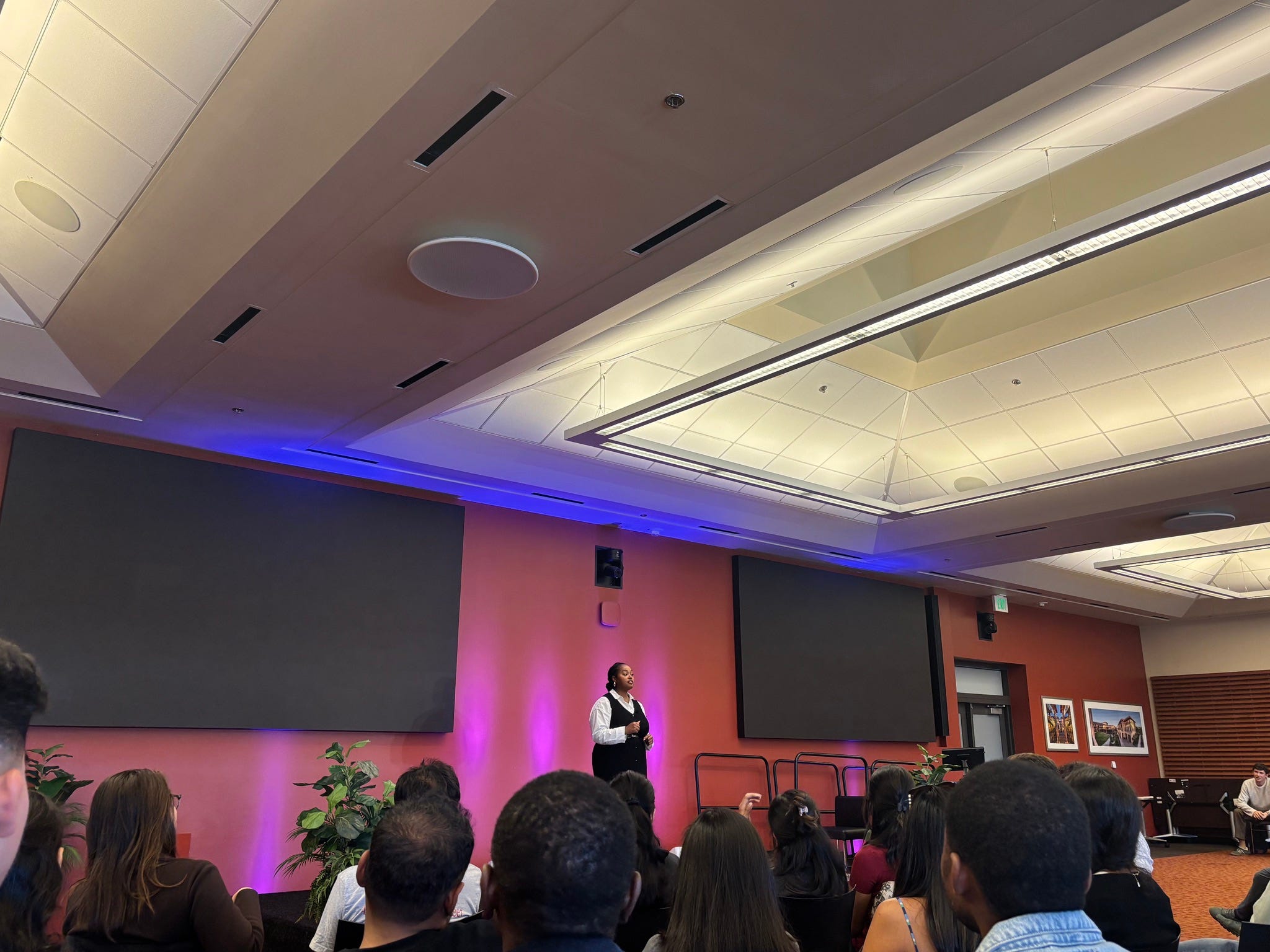
I opened with a perspective I feel deeply in my soul.
I HATE running. It’s hard and I’m not good at it. But after getting bullied by my roommate to run the Napa 5K with her last year and running the entire thing, I was hooked on the challenge of improving. I wanted to prove to myself that I could get better at something I wasn’t good at.
I’ve been running consistently since August which means showing up even when I don’t want to. I’ve since shaved 4 minutes off of my 5K time. I still hate running, but a pace that used to be my race pace has become my easy pace.
There was no shortcut to that improvement. No way around the twice weekly runs or Disney World “fast pass” equivalent to circumvent the slog. The only metric it came down to was time on feet.
We celebrate overcoming the struggle in sport, but criticize ourselves when we struggle while learning. We love the comeback—we just don’t like to live through the part where we’re not good yet. And for the first time in history, we have tools that can help us skip that part.
So, what do we lose when we skip the struggle? And when should we prioritize efficiency versus moving through what Brene Brown poignantly calls “the messy middle”?
I’ve come to the conclusion that we should choose to struggle more.
An insane statement considering the countless lives we’ve all lived in the past decade and a half. But struggling through learning is an essential mechanism for our brain function. This struggle shapes us and makes us human. It’s what makes us better at problem solving and drives our critical thinking. Doing the work is the path of most resistance, but it’s also the only proven path to becoming educated students, competent professionals, and informed citizens.
We’re already seeing what happens when we bypass it. In a randomized controlled trial at a university in Budapest, researchers found that students who used AI tools without guardrails scored up to 40 percentage points lower than students who did the thinking themselves.
So here’s the question I’d like to pose to you: if struggling is the price of learning, are we still willing to pay it?
We must. Everyone who sees this is in a position to influence others regardless of position or title. Many of us are young enough to upskill quickly on the latest drop of AI tools, but not so young that we don’t remember a time without them.
The next generation won’t be so lucky.
If you’re interested in the neuroscience behind this, you can read more about it here. The skinny is this: our brains are not passive receivers of information. Instead, they act like scientists: forming, testing, and adjusting hypotheses. We need enough data to learn from our mistakes and update our mental models. In other words, our brains need reps. Reps that take learning from memorize-recite-forget to dream-create-innovate. And AI is the first tool that can do the reps for us… if we let it.
But what happens when we realize the reps were the point?
I’ll be the first to tell you—AI is ingrained in my workflows. I’m not sure I would have made it through my first year of business school without it. And yet, I’m at a crossroads where I’m examining my habits to redefine how I want to engage with the tools of the future.
I spent last summer living in Georgia with my niece and nephew, supporting them through their summer enrichment homework. I was in awe of their AI-native childhoods in the same way I imagine millenials see my early Gen Z digital-native childhood. They talk to Chat GPT like they would speak to a friend. Somehow, innately, they understand the difference between the natural language queries an LLM can decode and the keyword-based queries on Google. I started thinking deeply about my own relationship with AI and how I can engage with these tools more effectively.
So when I sat down to write a piece for nondisclosure, the Stanford Business School student-run magazine, I knew two things to be true:
I didn’t know what to write; and
I was resolved to refrain from using AI to draft it.
Naturally, much like I did when sitting down to write this post, I struggled. And initially, I hated every word I wrote. I kept scrolling through the thoughts I’d previously braindumped searching for a paragraph I liked, let alone an entire article. In my time at Stanford, I had inadvertently built up my muscle to turn to my LLM of choice in a time such as this and believe me—it would have been so easy.
After all, Chat was starting to sound more like me than I did myself.
And then… there was a moment when I read back over something I’d written. I let it sink in for a bit. I sat with it. I realized I didn’t hate it. It sounded like me. The pre-AI version of me who poured my heart out in a two-post blog series during the United States’ (short-lived) racial reckoning of 2020. The version of me who conceived, researched, and wrote a 50-page final paper on southern ingredients as a vehicle for history and culture throughout time. The version of me who poured my heart out about how my dad is my hero in response to a Humans of New York’s request for quarantine submissions. The version of me who contributed to two chapters in a textbook on Health and Human Rights under Dr. Benjamin Mason Meier, one the most brilliant people, professors, and scholars I’ve ever met.
And that was all it took for me to get hooked on the challenge of sticking with it.
When my draft was finally done two weeks later, I was full of pride. I felt stronger—like I’d built back the parts of my brain that had been on extended hiatus since the version of me I used to know. It wasn’t perfect, but it was entirely mine.
In that struggle, I realized that learning isn’t so much the shortest path to an answer. Learning is what happens in the midst of the journey through our questions. Brookings Institute researchers sum this up well in a report on education and AI: “struggling to find [our] own words and pursue [our] own questions is what makes learning meaningful and life worth living.”
So what now? Are we supposed to be racked with moral guilt every time we pull up an LLM? Should we avoid using AI tools at all?
Perhaps not obvious from what I’ve written here and therefore should be said explicitly: I’ve never been anti-AI—in fact, taking this position would be a mistake. To live and work in 2026 is to embrace the future ways of working. Those of us who dig our feet in on progress will almost certainly get left behind. We’re seeing the emergence of a new social order: 1) tech giants who are thinking critically about how and when AI should be woven into their workflows to protect creativity, and 2) folks driven to overconsumption of AI tools by the very same tech giants.
For now, I’m thinking about the immediate changes I can make to retool my relationship with AI. Here are three ways I’ve been engaging with these tools promising to boost our efficiency:
The Researcher: I use Gen AI tools like NotebookLM to parse and collate sources.
The Challenger: I use LLMs like Claude and Chat to test and strengthen my final product.
The Personalizer: I use Speechify and NotebookLM to change the format of my content—presentations, podcasts, etc.—not skip the thinking.
These tools will clearly have an amazing impact on our workflows. But we can’t cede the hard work associated with learning and creativity—the very things that make us human—to technology.
For so many of us, learning has been about optimizing for achievement. I hope I’ve convinced you it can be so much more than driving towards an outcome. Daring to embrace the struggle differentiates leaders from followers. My 5K medal was more than a piece of hardware, but a reminder that I can and should do hard things. And if you want to see the gains, you can’t skip the reps.
I was obsessed with this as a talk, and even more so as a Substack! It so very well aligns with the findings from my research last quarter in this ‘Technology for Learners’ class I took at the ed school. My loooong procrastinated Substack has been about my findings from that research about how the struggle of learning is the path to learning. I’ll quote this your piece in that whenever I get around to publishing it. We are soooo aligned on this. Also, your writing is a gift. Can’t wait for more!
Yes, let AI be a junior teammate than the leader. It will be futile to ignore AI in 2026 and future workflows.
Your piece is persuasive and well reasoned. Great job!